New Open Access Chapter on Eurocentrism in Regionalism Theories

An open-access chapter on why regionalism theories can appear universal yet still carry Europe-based assumptions, published in UNU-CRIS’s two-volume Essays on Global Regionalism project.
Dr. Ivo Ganchev has published a new open-access essay examining a persistent puzzle in the study of regional integration: why regional organisations in Africa, Latin America, and parts of Asia are so frequently portrayed in the scholarly literature as “ineffective,” “dysfunctional,” or even “failed.”
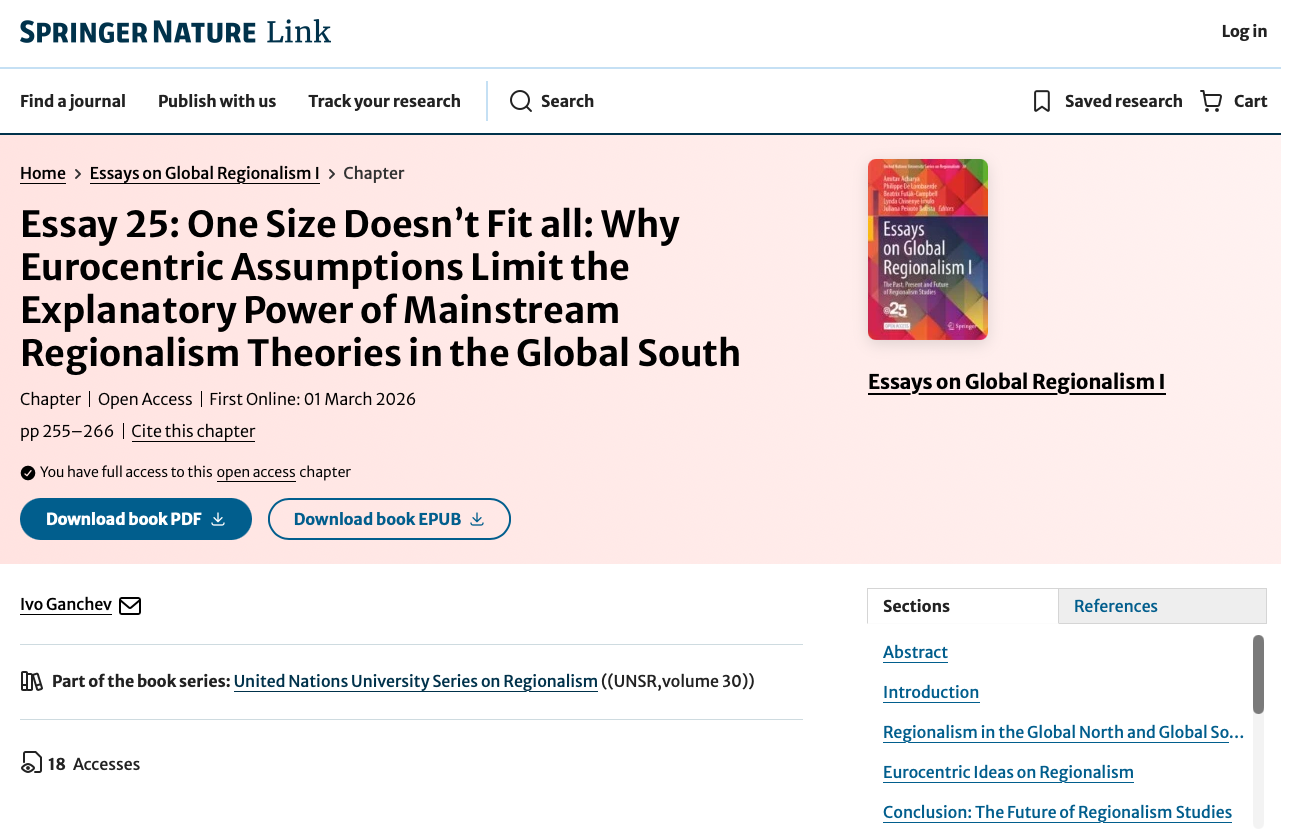
The chapter—“One Size Doesn’t Fit All: Why Eurocentric Assumptions Limit the Explanatory Power of Mainstream Regionalism Theories in the Global South”—appears as Essay 25 in Essays on Global Regionalism I: The Past, Present and Future of Regionalism Studies, edited by Amitav Acharya, Philippe De Lombaerde, Beatrix Futák-Campbell, Lynda Chinenye Iroulo, and Juliana Peixoto Batista.
The essay’s core claim is diagnostic. It argues that several influential theories of regional integration (such as federalism, functionalism/neofunctionalism, and transactionalism) were in practice shaped by Europe’s distinctive historical and political conditions, and shows that this origin matters for how they travel. When such theories are applied as universal yardsticks, they can quietly embed the EU’s trajectory into the baseline of “successful integration,” shaping both what scholars expect to see and what they count as evidence when evaluating regionalism beyond Europe. The chapter also considers newer agendas, including new regionalism and comparative regionalism, arguing that they offer important progress but still tend to yield partial explanations, while comparison itself can reproduce bias through the assumptions that guide case selection and benchmarking.
The chapter closes with a practical proposal for where the field should go next. It outlines five steps to create space for a genuinely Global South–attuned theory of regionalism: treating the EU as a sui generis case, foregrounding historical conditions, prioritising explanation before critique, strengthening independent research capacity in the Global South, and embracing pluralism rather than a single integration blueprint.
This publication sits within a wider debate in International Relations. It is included in Essays on Global Regionalism I, the first of a two-volume book project produced for the 25th anniversary of the United Nations University Institute on Comparative Regional Integration Studies (UNU-CRIS). The project brings together 101 short essays/think pieces by scholars from around the world, organised around a shared question: whether and how regionalism studies can be meaningfully globalised, in conversation with debates on Global IR and knowledge production beyond Europe and the North Atlantic. The editors describe the project as a response to a longstanding contradiction: regionalism has been global in practice, while key strands of the theoretical literature have remained comparatively parochial or EU-centric.
Both volumes are published as open-access books under a Creative Commons Attribution 4.0 (CC BY) licence, and the publication is explicitly supported by UNU-CRIS, widening access for researchers, students, and practitioners worldwide.
Publication Details: Ganchev, I. (2026). “One Size Doesn’t Fit All: Why Eurocentric Assumptions Limit the Explanatory Power of Mainstream Regionalism Theories in the Global South.” In A. Acharya, P. De Lombaerde, B. Futák-Campbell, L. C. Iroulo, & J. Peixoto Batista (eds.), Essays on Global Regionalism I: The Past, Present and Future of Regionalism Studies (United Nations University Series on Regionalism 30, pp. 255–266). Springer, Cham.
Read the chapter here or download it from ResearchGate or Academia.edu.
Read Volume I here.
Read Volume II here.